Star Jewel Display Font for Handmade Creators
If you've ever spent hours tweaking a label, re-cutting a sticker because the letters didn’t hold up on your Cricut, or hesitated before listing a printable because the typography felt “off,” then you know how much weight the right display font carries in your shop. That’s why I reached for Star Jewel the moment I saw it—and haven’t put it down since. It’s not just another playful typeface. It’s a reliable, joyful, commercially smart tool that makes my physical products feel more intentional, more memorable, and more *mine*.
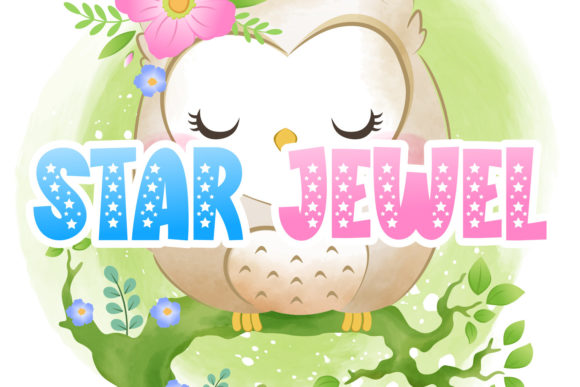
Star Jewel is a display font with genuine charm—rounded, friendly letterforms, gentle contrast, and a subtle bounce in its rhythm. It doesn’t shout; it smiles. There’s no forced whimsy or over-the-top decoration. Instead, it balances authenticity with clarity: each character reads cleanly at small sizes (think 8–12 pt on product tags), yet expands beautifully at 60+ pt for wall art or welcome signs. Its personality lands squarely between “hand-drawn warmth” and “polished craft”—a sweet spot many handmade sellers chase but rarely nail without extra design work.
I use Star Jewel across nearly every category in my shop: custom candle labels (especially for kids’ birthday scents like “Rainbow Sprinkle” or “Unicorn Dreams”), boutique gift tags for baby shower favors, printable classroom posters for homeschool co-ops, and even vinyl-cut designs for reusable lunchbox stickers. Because it’s a true display font, it shines best where impact matters most—titles, names, short phrases, and focal points—not long paragraphs. That’s actually a strength: it keeps your customer’s eye exactly where you want it, whether that’s the child’s name on a personalized invitation or the flavor name on a jar of small-batch jam.
Readability on cutting machines? Solid. I’ve run Star Jewel through both Cricut Design Space and Silhouette Studio at 0.25" height for mini sticker sheets—and every letter cut cleanly, with no fragile serifs or thin joins breaking apart. For printed cards and packaging, I’ve tested it on uncoated kraft paper and glossy sticker stock, and it holds contrast well without ink bleed. Pro tip: avoid using it below 6 pt for fine-print details (like copyright lines or ingredient lists); pair it instead with a crisp sans serif for those elements.
Here’s where Star Jewel truly earns its place in my design toolkit:
- Birthday invitations: Use it for the child’s name and event title—then switch to a relaxed script font for “You’re Invited” and a clean sans for date/time/location.
- Farmhouse-style signs: Pair it with a warm serif (like Playfair Display) for layered depth—Star Jewel as the main phrase (“Gather Here”), serif for the subtext (“Est. 2023”).
- Digital printables: Planner headers, habit trackers, and classroom reward charts all feel more inviting with Star Jewel anchoring the theme—its openness prevents visual clutter, even with busy layouts.
- Product packaging: On soap labels, tea tins, or cookie boxes, it gives handmade goods an approachable, premium feel—no expensive foil stamping needed.
- Seasonal crafts: It works year-round—think “Jingle All the Way” on holiday tags, “Sunshine & Sand” on summer camp water bottles, or “Back to School” banners with hand-lettered accents.
Font pairing is intuitive with Star Jewel. Its friendly geometry plays well with both contrast and harmony. Try it with:
- A soft script font (like “Lavanderia” or “Quicksand Script”) for greeting cards—Star Jewel for the headline, script for the sentiment.
- A neutral sans serif font (like Montserrat or Poppins) for balance in SVG files or editable templates—Star Jewel draws attention, the sans keeps things legible and scalable.
- An understated serif font (like Cormorant Garamond) for wedding welcome boards or boutique stationery—Star Jewel adds lightness, the serif adds timeless structure.
The version I purchased includes OTF and TTF files, standard Latin character sets (A–Z, numbers, basic punctuation), and no ligatures or swashes—keeping it simple, stable, and production-ready. No multilingual expansion, so if you serve Spanish- or French-speaking markets regularly, double-check diacritical support before committing to large-scale packaging. That said, for English-first shops focused on kids’ products, school supplies, or family-centered brands, it covers everything you need without bloat.
Licensing matters—especially when you’re selling physical products or digital downloads. The commercial license I bought explicitly allows use in merchandise (mugs, totes, shirts), printable templates, SVG cut files, client projects, and Etsy listings. That means I can embed Star Jewel into a Canva template I sell, convert it to outlines for a Cricut-compatible SVG, or print it directly onto fabric labels—no attribution required. Just make sure your license covers your intended use case: some free versions restrict resale, and some premium bundles limit output volume. When in doubt, read the EULA—not just the sales page.
What stands out most about Star Jewel isn’t just how it looks—it’s how it works. It doesn’t ask me to compensate for its quirks. It doesn’t require kerning adjustments on every word. It doesn’t lose personality when scaled down or lose legibility when printed on textured paper. In a world where handmade sellers juggle design, production, and marketing, that kind of reliability is rare—and invaluable. Whether you're designing a single batch of farmer’s market tags or launching a full line of educational printables, Star Jewel helps your message land with warmth, clarity, and quiet confidence.